The problem
A request for hosting, networking, or an application rarely contains enough information to scope the work. H-DCS connects service presentation with structured requirements and internal quoting, while keeping infrastructure operations under explicit control.
My contribution
I develop the Blazor application, business services, data model, agent integration, and deployment workflows. This case study concerns the H-DCS service platform; the broader H-DVM and H-DPanel work remains covered in the separate application-platform overview.
The design
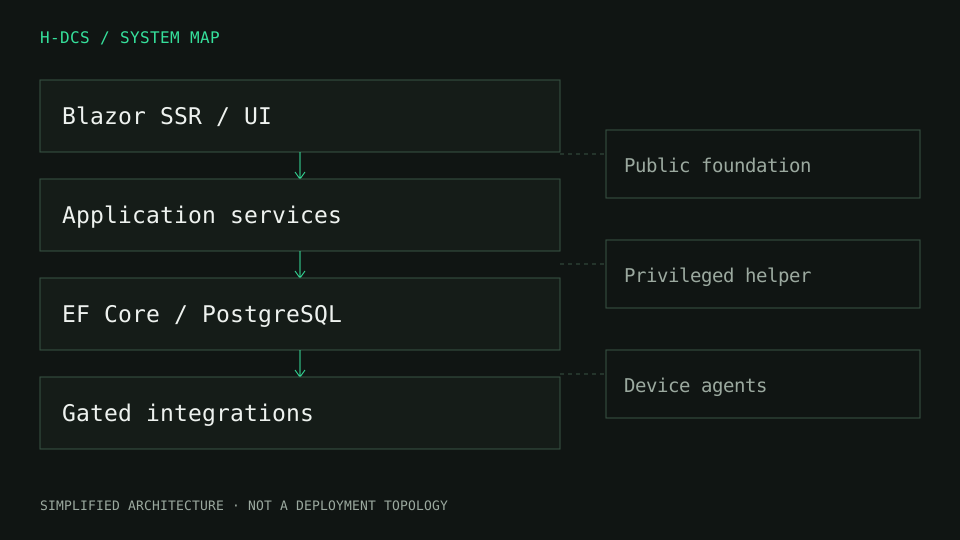
Blazor SSR and interactive server components call application services backed by EF Core and PostgreSQL. External operations, background workers, account workflows, and privileged helpers have explicit activation boundaries. The Linux agent polls outward and accepts a fixed command set.
A difficult problem: reducing functionality safely
The public foundation deployment must remain useful without exposing account, payment, provisioning, or administrative workflows. Hiding navigation was insufficient. The implementation adds request allowlists, component-navigation checks, and disabled operational settings. Tests cover both refused operations and the public assets and Blazor transport that must remain available.
Evidence and status
The reviewed deployment records describe staged regional rollout, separate runtime and initialization privileges, preserved releases, and sampled recovery checks. They also record open monitoring and operational acceptance work. These are bounded engineering results, not uptime or capacity guarantees.
Read the architecture and operational lessons. Explore the wider H-DCS application work.